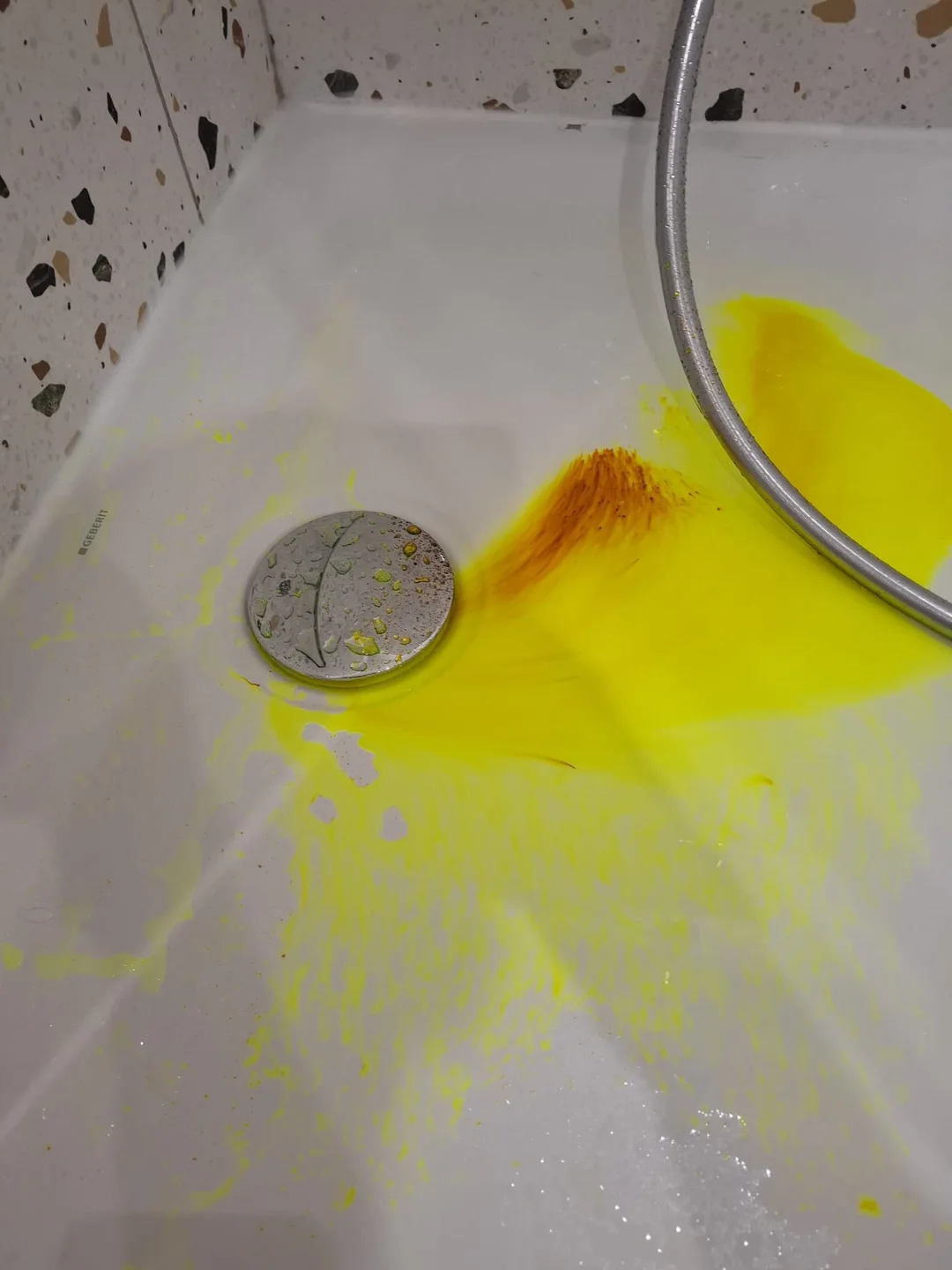
Dye traces the water; diagnosis still requires other evidence
A tracing dye is introduced into a water flow or applied to an area being tested. If it appears elsewhere, it confirms a water path. The test links a starting area to an observation point, helping us investigate the defect along that route.
A basin waste pipe, a shower and the seal around a shower tray are different possible sources. Tests are carried out separately to establish which one reproduces the problem. In one of our team's investigations, the basin tracer appeared at the concealed trap-to-PVC connection; the shower tracer did not appear in that opening.
Waste pipes, seals, terraces and rainwater
- Check a waste trap, a waste pipe connection or a soil stack.
- Check whether water passes through a seal around a basin or shower.
- Test an accessible terrace, balcony or water ingress area section by section.
- Distinguish between plumbing and rainwater sources when they leave marks close together.
Prepare the observation point before introducing water
We need to be able to observe where water may emerge: beneath a fixture, through an inspection hatch, in a cellar or in a neighbour's flat. Access is therefore arranged before the test. In a cast-iron stack investigation, water was observed in the cellar while water was run from the flats.
The technician selects the product, concentration and test areas to suit the materials and site conditions. They record where the dye was applied, the observation point and the result. Supply pressure testing or moisture readings can complement the investigation; they answer different questions.
What a negative test result tells you, and its limits
If no dye appears at the observation point, that tells us about the specific test performed. It does not rule out every possible water path: an area may be inaccessible, or the conditions may not have reproduced the leak during the test. The conclusion retains these limitations.
The report distinguishes between an observed water path, a likely source and a connection that is actually visible. See an example of a waste pipe tested with two tracers.
Your questions before the visit
Does testing a shower waste pipe also test the shower tray seals?
These are two different checks. Water poured into the waste outlet follows the drainage system; a targeted perimeter test checks whether water passes through seals or finishes. The areas are tested separately to avoid confusing the results.
Why use different tracers?
Where the test procedure calls for them, they distinguish between the water flows tested. In the basin and shower case, it was the basin tracer that appeared at the faulty connection. The full account is in our inspection examples.
Do we need access to the neighbour's flat during the test?
If that is where the marks need to be observed, access helps verify the result. Without access, the report may need to state a limitation rather than confirm the source.
Is there a fixed fee for each dye used?
No. The investigation is priced according to its difficulty and whether it requires destructive openings. The methods are selected for the job; they are not added together as fixed fees per device. See prices.